
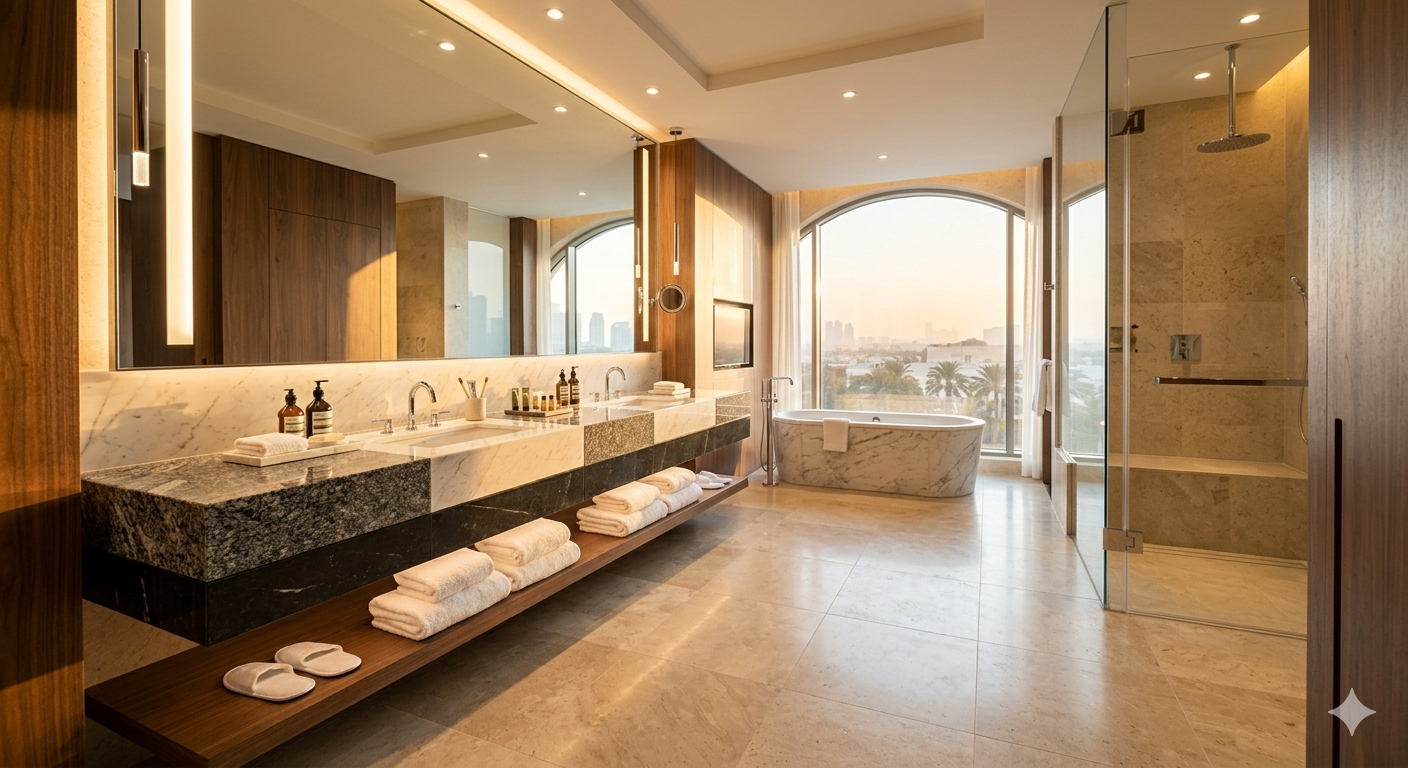
Hotel Bathroom Vanity Stone: Spec Requirements for FF&E Buyers
Meta Description: Complete FF&E specification guide for hotel bathroom vanity stone. ASTM standards, ADA compliance, durability requirements, and sourcing tips for hospitality projects.
Hotel Bathroom Vanity Stone: Spec Requirements for FF&E Buyers
You’re writing the FF&E specification for a 250-room hotel. The bathroom vanity tops need to arrive on schedule, meet ADA compliance, withstand daily housekeeping, and look pristine after 5 years of use.
But what exactly do you specify?
Most FF&E buyers inherit specifications from previous projects or copy-paste from vendor catalogs. That works until something goes wrong — a slab arrives with unacceptable veining, the edge profile doesn’t match the drawing, or the thickness is wrong.
This guide covers the technical specifications that matter for hotel bathroom vanity stone: material standards, dimensional requirements, surface finishes, edge profiles, and how to avoid costly mistakes.
Table of Contents
- [Why Specifications Matter for Hotel Stone](#why-specs)
- [Material Standards & Certifications](#material-standards)
- [Dimensional Specifications](#dimensions)
- [Surface Finish Requirements](#finish)
- [Edge Profiles & Details](#edges)
- [Sink Cutout Specifications](#sink-cutouts)
- [Durability & Performance Testing](#durability)
- [Quality Control & Inspection](#qc)
- [Common Specification Mistakes](#mistakes)
- [FAQ: FF&E Stone Specs](#faq)
- [How to Write Your Spec](#cta)
Why Specifications Matter for Hotel Stone
A vague specification leads to:
Cost overruns — Supplier interprets your intent differently. Change orders pile up.
Schedule delays — Shop drawings go back and forth 3-4 times because the spec was unclear.
Quality issues — Stone arrives with veining that doesn’t match the sample. Edges are chipped. Thickness is off.
Contractor frustration — Installation crew can’t proceed because the material doesn’t match the drawing.
A tight specification prevents all of this. It takes 2-3 hours upfront to write a good spec, but saves weeks of back-and-forth and prevents $10K+ in change orders.
Material Standards & Certifications
ASTM Standards for Dimensional Stone
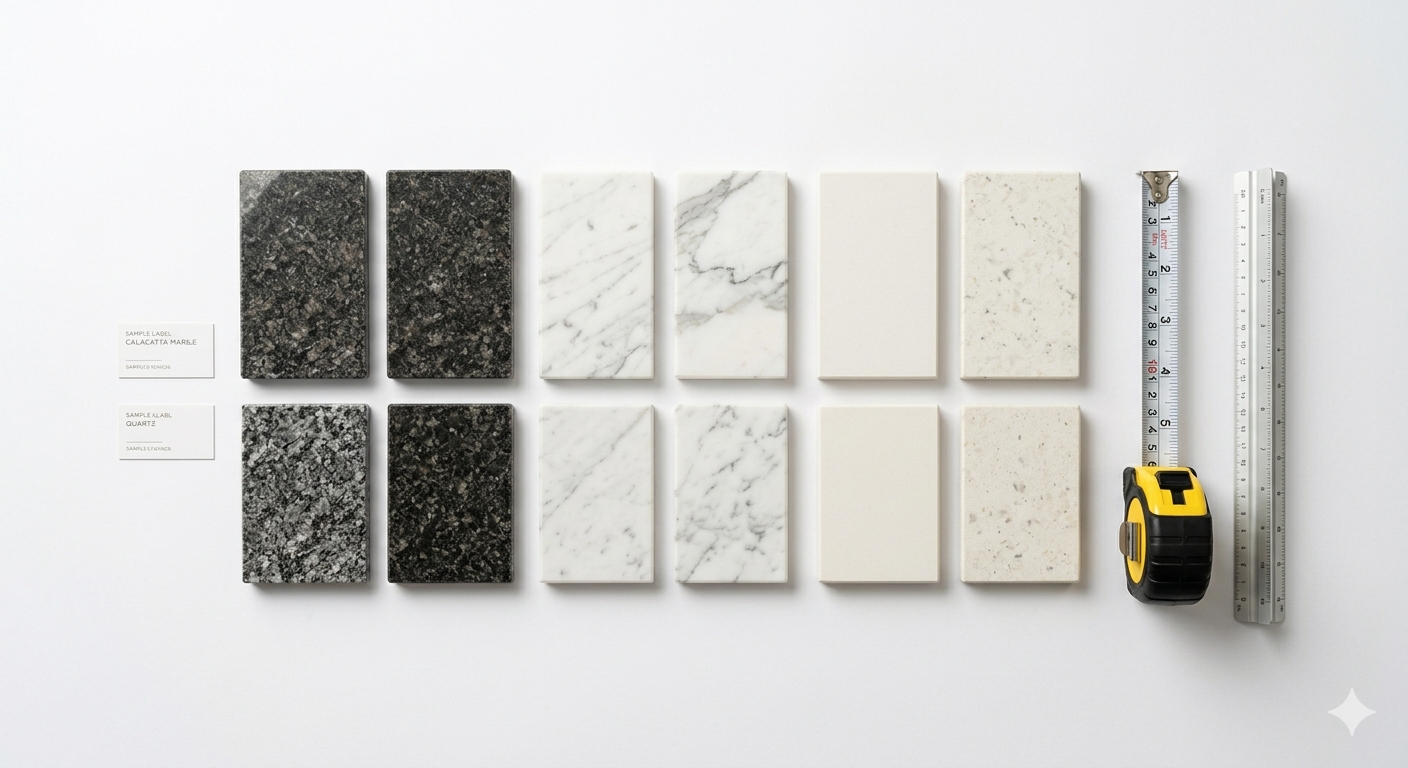
If you’re specifying natural stone (granite, marble), reference these ASTM standards:
ASTM C615 — Standard Specification for Granite
- Applies to: Granite countertops, vanity tops, architectural stone
- Key requirements:
- Compressive strength: minimum 19,000 psi
- Modulus of rupture: minimum 1,300 psi
- Water absorption: maximum 0.4%
- Abrasion resistance: measured by ASTM C241
ASTM C503 — Standard Specification for Marble
- Applies to: Marble, limestone, travertine countertops
- Key requirements:
- Compressive strength: minimum 2,000 psi (varies by type)
- Modulus of rupture: minimum 400 psi
- Water absorption: maximum 0.75%
- Acid resistance: marble etches in acidic conditions (expected)
ASTM C1313 — Standard Specification for Manufactured Quartz Countertop Products
- Applies to: Engineered quartz (Caesarstone, Silestone, LG Viastone)
- Key requirements:
- Quartz content: minimum 90%
- Compressive strength: minimum 35 MPa
- Flexural strength: minimum 30 MPa
- Water absorption: <0.1%
- Stain resistance: tested per ASTM D3359
What to Include in Your Spec
MATERIAL SPECIFICATION:
Bathroom vanity tops shall be constructed of [GRANITE / MARBLE / QUARTZ]
conforming to ASTM [C615 / C503 / C1313].
Material shall be sourced from [supplier name] and shall match the
approved material sample dated [date] provided by [FF&E consultant].
All stone shall be inspected for dimensional accuracy, surface finish,
and color consistency prior to shipment.
Dimensional Specifications
Standard Hotel Vanity Top Sizes
Hotel bathrooms typically use standardized vanity widths to reduce SKU complexity and improve delivery speed:
| Vanity Width | Depth | Thickness | Common Use |
|---|---|---|---|
| 24″ | 21″ | 1.25″ | Single sink, small rooms |
| 30″ | 21″ | 1.25″ | Single sink, standard rooms |
| 36″ | 21″ | 1.25″ | Single sink, larger rooms |
| 48″ | 21″ | 1.25″ | Double sink, suites |
| 60″ | 21″ | 1.25″ | Double sink, luxury suites |
Thickness Standards
1.25″ (standard) — Most cost-effective. Sufficient for bathroom vanity use. Requires edge banding for structural support.
1.5″ (premium) — Thicker appearance, more durable edge. Typically 15-20% cost premium.
2″ (luxury) — Dramatic appearance, maximum durability. Used in high-end hospitality. 30-40% cost premium.
Tolerance Specifications
Dimensional tolerances should be tight for hotel projects. Include this in your spec:
DIMENSIONAL TOLERANCES:
Length and width: ±1/8"
Thickness: ±1/16"
Sink cutout diameter: ±1/8"
Sink cutout depth: ±1/8"
All vanity tops shall be square and flat within 1/16" over 10 linear feet.
Example Spec Line
Vanity tops shall be 48" wide × 21" deep × 1.25" thick,
granite, with 2" radius edge profile and 19" diameter undermount sink cutout
located 12" from left edge, 8" from front edge.
Tolerance: ±1/8" on all dimensions.
Surface Finish Requirements
Stone finish affects both aesthetics and maintenance in a hotel bathroom.
Common Finishes for Hotel Vanity Tops
Polished
- Shiny, reflective surface
- Shows fingerprints and water spots
- Easiest to clean
- Most luxurious appearance
- Best for: High-end hotels, suites, properties with daily housekeeping
Honed
- Matte, smooth surface
- Hides fingerprints and water spots
- Still easy to clean
- More contemporary appearance
- Best for: Modern hotels, mid-range properties, high-traffic bathrooms
Leathered
- Textured, matte surface
- Hides dust and fingerprints
- Requires more aggressive cleaning
- Trendy, upscale appearance
- Best for: Luxury properties, contemporary design
Brushed
- Lightly textured, subtle sheen
- Hides water spots
- Professional appearance
- Best for: Business hotels, contemporary designs
Specification Example
SURFACE FINISH:
All vanity tops shall have a polished finish per ASTM C1306
(surface roughness Ra ≤ 0.8 µm).
Finish shall be uniform across the entire surface with no dull spots,
scratches, or inconsistencies visible from 3 feet away under standard lighting.
Edge Profiles & Details
Edge profile is a critical detail that impacts both aesthetics and durability.
Common Hotel Edge Profiles
2″ Radius (Bullnose)
- Smooth, rounded edge
- Safe for guests (no sharp corners)
- Most forgiving for tolerances
- Standard for most hotels
- Cost: Baseline
Beveled
- 45-degree cut edge
- Contemporary appearance
- Slightly more expensive than radius
- Cost: +10-15%
Ogee
- Curved, decorative edge
- Luxury appearance
- Requires precise fabrication
- Cost: +20-25%
Straight (Square)
- Sharp, modern edge
- Requires protective edge banding
- Less common in hospitality
- Cost: Baseline but requires banding
ADA Compliance Note
For public bathrooms or accessible rooms, edge profiles must be safe. Round edges (2″ radius minimum) are preferred. Sharp edges can create liability issues.
Specification Example
EDGE PROFILE:
All exposed edges shall have a 2" radius bullnose profile per [supplier]
detail drawing [number]. Edges shall be smooth and free of chips or irregularities.
Backsplash (if applicable): 4" tall × 1.25" thick, matching material,
with 1" radius top edge.
Sink Cutout Specifications
Sink cutouts are where most mistakes happen. Be specific.
Undermount vs Overmount
Undermount (preferred for hotels)
- Sink mounted from below
- Cleaner appearance
- Easier to clean (no rim lip)
- Requires precise cutout
- More expensive fabrication
Overmount (budget option)
- Sink sits on top of vanity
- Easier installation
- Visible rim
- Less precise cutout required
Cutout Specifications
SINK CUTOUT SPECIFICATION:
Sink type: Undermount, vitreous china, [brand/model]
Cutout diameter: 19" ± 1/8"
Cutout depth: 6.5" ± 1/8"
Cutout location: 12" from left edge, 8" from front edge
Edge finish: Polished, smooth, no chips
Drainage hole: 1.5" diameter, 2" from rear edge
Fabricator shall provide shop drawing showing exact cutout location
and dimensions. Cutout shall be tested with actual sink before shipment.
Critical Detail: Overhang
Specify how much the vanity top overhangs the cabinet:
OVERHANG SPECIFICATION:
Front overhang: 1.5" (prevents toe kick contact)
Side overhang: 0.5" (aligns with cabinet sides)
Rear overhang: 0" (against wall, no overhang)
Durability & Performance Testing
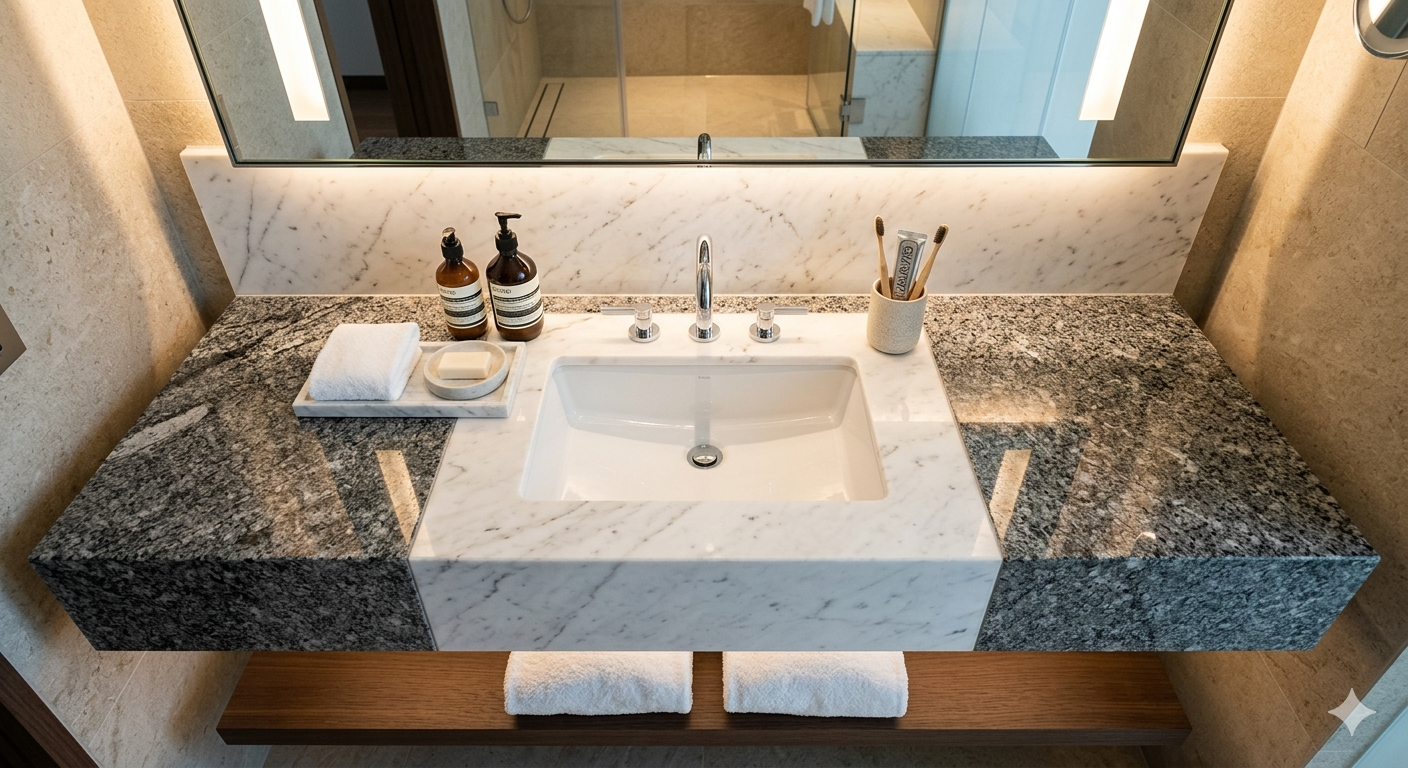
For hotel stone, specify performance standards so there’s no ambiguity.
Key Performance Tests
Abrasion Resistance (ASTM C241)
- Measures scratch resistance
- Lower numbers = more scratch-resistant
- Granite: typically 4-8 Mohs hardness
- Spec: “Granite shall have abrasion resistance rating ≥ 6 per ASTM C241”
Water Absorption (ASTM C97)
- Measures porosity
- Lower = better (less staining)
- Granite: <0.4%
- Marble: <0.75%
- Quartz: <0.1%
Acid Resistance (ASTM C217)
- Measures resistance to acidic cleaners
- Applies to marble (which will etch)
- Granite and quartz are more acid-resistant
Thermal Shock (ASTM C1026)
- Measures resistance to temperature changes
- Important for bathrooms with hot showers
- Granite: excellent
- Marble: good
- Quartz: excellent
Specification Example
PERFORMANCE REQUIREMENTS:
All stone shall meet or exceed the following:
• Abrasion resistance: ≥ 6 Mohs per ASTM C241
• Water absorption: ≤ 0.4% per ASTM C97
• Compressive strength: ≥ 19,000 psi per ASTM C615
• Flexural strength: ≥ 1,300 psi per ASTM C880
Stone shall be tested and certified by an independent lab prior to shipment.
Test reports shall be provided to FF&E consultant.
Quality Control & Inspection
Don’t rely on the supplier’s QC alone. Build inspection into your spec.
Pre-Shipment Inspection
QUALITY CONTROL & INSPECTION:
1. Dimensional verification: All pieces measured against shop drawings.
   Tolerance: ±1/8" on length/width, ±1/16" on thickness.
2. Surface inspection: Examined under bright light for scratches, chips,
   dull spots, or color inconsistencies. Standard: visible from 3 feet away.
3. Edge inspection: All edges smooth, no chips, consistent radius.
4. Sink cutout test: Actual sink test-fit to verify fit and finish.
5. Finish consistency: All pieces have uniform polish/hone finish.
   No variation between pieces.
6. Packaging: Each piece individually wrapped. Crated with foam padding
   and corner protection. Damage rate: <0.5%.
Supplier shall provide signed inspection report before shipment.
Third-Party Inspection Option
For large projects (200+ rooms), consider hiring an independent inspector in Vietnam to inspect stone before shipment. Cost: typically $500-$1,500, but prevents $20K+ in damage claims.
Common Specification Mistakes
Mistake #1: Vague Material Description
WRONG: “Granite vanity tops”
RIGHT: “Granite vanity tops, [Supplier Name], [Quarry Name], [Color],
conforming to ASTM C615, matching approved sample dated [date]”
Mistake #2: No Tolerance Specification
WRONG: “Vanity tops 48″ wide”
RIGHT: “Vanity tops 48″ ± 1/8″ wide, measured at three points”
Mistake #3: Unclear Edge Profile
WRONG: “Rounded edge”
RIGHT: “2” radius bullnose edge per detail drawing A-4.2, polished finish”
Mistake #4: No Sink Cutout Detail
WRONG: “Undermount sink cutout”
RIGHT: “Undermount sink cutout, 19″ diameter ± 1/8″, 6.5″ deep ± 1/8”,
located 12″ from left edge, 8″ from front edge per shop drawing”
Mistake #5: No QC/Inspection Requirements
WRONG: Assume supplier will deliver perfect stone
RIGHT: “Supplier shall provide pre-shipment inspection report signed by
quality manager. All pieces shall be individually wrapped and crated with
foam padding.”
Mistake #6: No Finish Specification
WRONG: “Polished granite”
RIGHT: “Polished granite per ASTM C1306, surface roughness Ra ≤ 0.8 µm,
uniform finish across all pieces”
FAQ: FF&E Stone Specs
1. What thickness should I specify for hotel vanity tops?
1.25″ is standard and cost-effective. 1.5″ is premium. 2″ is luxury. For most hotels, 1.25″ with a 2″ radius edge is the sweet spot.
2. Should I specify polished or honed finish?
Polished looks more luxurious but shows water spots and fingerprints. Honed hides water spots and is more contemporary. For high-traffic bathrooms, honed is more practical.
3. What’s the most common edge profile for hotels?
2″ radius bullnose. It’s safe (no sharp corners), forgiving for tolerances, and cost-effective.
4. How do I prevent sink cutout mistakes?
Specify the exact diameter, depth, and location in your drawing. Have the fabricator provide a shop drawing showing the cutout. Test-fit the actual sink before shipment.
5. What tolerances should I specify?
±1/8″ on length/width, ±1/16″ on thickness. These are tight enough to prevent installation issues but realistic for stone fabrication.
6. Do I need to specify ASTM standards?
Yes. ASTM C615 (granite), C503 (marble), and C1313 (quartz) are industry standards. They protect you by defining minimum material performance.
7. What’s the difference between polished and honed finish?
Polished: shiny, reflective, shows water spots and fingerprints. Honed: matte, smooth, hides water spots. Polished is more luxurious; honed is more practical.
8. How do I specify color consistency?
Reference an approved material sample dated [date]. State: “All stone shall match the approved sample within acceptable color variation for natural stone” or “All pieces shall be from the same quarry/batch to ensure color consistency.”
9. Should I require third-party inspection?
For projects over 150 rooms, yes. It costs $500-$1,500 but prevents costly damage claims and delays.
10. What should I include in the shop drawing request?
Dimensions, edge profile, sink cutout location and size, backsplash (if applicable), overhang, surface finish, and any special details. The fabricator should return a detailed drawing for your approval before production.
How to Write Your FF&E Stone Specification
Step 1: Identify Your Material
- Natural stone (granite/marble) or engineered (quartz)?
- Which supplier? Which quarry/color?
- Reference an approved sample.
Step 2: Define Dimensions
- Vanity width, depth, thickness
- Sink cutout size and location
- Overhang (front, side, rear)
- Include tolerances (±1/8″ typical)
Step 3: Specify Finish & Edge
- Surface finish (polished/honed/leathered)
- Edge profile (2″ radius, beveled, etc.)
- Reference detail drawings
Step 4: Add Performance Standards
- ASTM standards (C615, C503, C1313)
- Abrasion resistance, water absorption
- Durability testing requirements
Step 5: Include QC & Inspection
- Pre-shipment inspection requirements
- Packaging standards
- Damage tolerance (<0.5%)
- Third-party inspection (if applicable)
Step 6: Request Shop Drawings
- Fabricator provides detailed drawings
- You approve before production
- Prevents costly mistakes
Need Help Writing Your Spec?
If you’re specifying stone for a hotel project and want to ensure compliance, durability, and on-time delivery, Hoàng Kha Stone can help.
We’ve supplied stone for 250+ hotel rooms across North America and understand FF&E requirements inside and out.
Contact us:
- Email: info@hoangkhastone.com / sales1@hoangkhastone.com
- US Office: +1 808-844-2929 (Honolulu, Hawaii)
- Website: hoangkhastone.com
Send us your FF&E specification, and we’ll provide a detailed quote, material samples, and shop drawings within 24 hours.
